

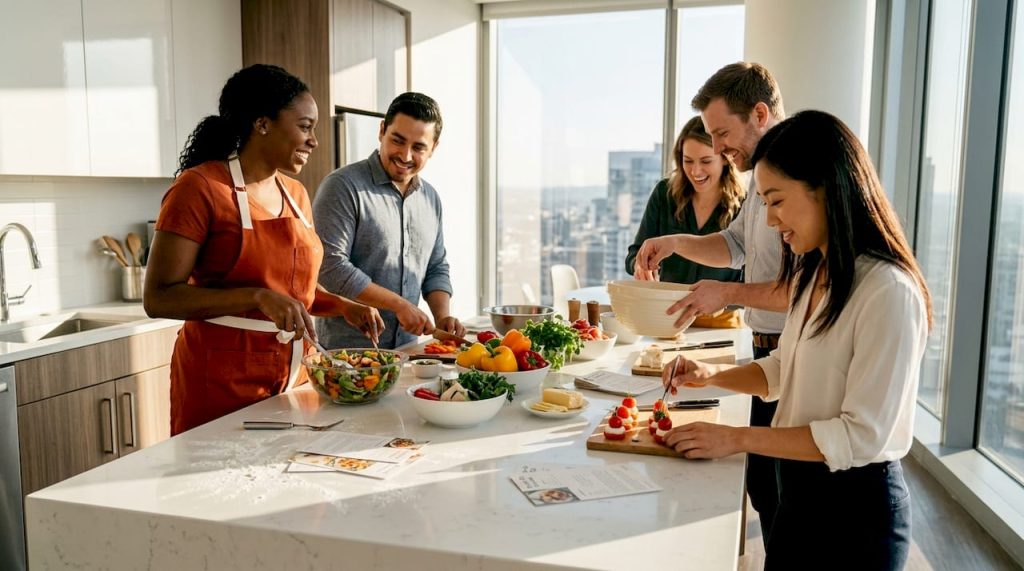
Company activities often fail because they ask people to perform enthusiasm instead of giving them a real task. Cooking provides a practical alternative. A group must plan, divide work, communicate, handle time pressure, and produce something everyone can share.
Milan is particularly suited to this format because teams can draw on Italian ingredients and live-fire methods while staying close to offices, transport, and event venues. The activity can be adapted for a small leadership group or a wider department.
The strongest sessions are not judged only by the final plate. They reveal how people make decisions, respond to mistakes, include quieter colleagues, and share limited equipment. Those behaviours often resemble what happens in daily work.
A well designed team building milano session gives each participant a useful role without forcing anyone to act like a television chef. Clear instructions, safe equipment, and achievable recipes let the team focus on working together.
Why cooking creates useful pressure
Recipes provide a goal, but the route still requires judgement. Ingredients arrive in a particular condition, heat changes during cooking, and one group may need a tool another group is using. Participants have to exchange information rather than complete isolated worksheets.
Time pressure is visible and limited. If vegetables need preparation before the grill is ready, the delay has an immediate effect. The consequence matters enough to focus attention, yet it remains low risk compared with a client deadline or operational failure.
Cooking also makes contribution easy to observe. One person may organize the work, another may notice quality, and someone else may keep the group calm. Leadership can shift as the task changes.
What the organizer should decide first
Begin with the business reason for the day. A new department may need introductions and trust. An established team may need better communication across roles. Managers may want to observe planning or give staff a break after a demanding period.
The objective affects group size and facilitation. Competitive scoring can energize some teams, but it may reinforce existing divisions. A shared meal assembled from several group contributions is often better when cooperation between departments matters.
Participation needs careful thought. Some colleagues may have limited mobility, sensory needs, religious food rules, allergies, or no desire to handle raw meat. An inclusive event provides roles in preparation, timing, seasoning, presentation, and service.
A format that keeps everyone involved
The opening briefing should cover safety, the menu, available equipment, and the expected outcome for each group. Instructions need enough detail to prevent confusion while leaving room for teams to organize themselves.
Groups of four to six usually allow each person to contribute. Larger groups can leave one confident participant doing most of the cooking. Rotating roles helps, though rotation should not interrupt a task at a dangerous moment.
A facilitator can ask short questions during the session. Who is checking time? Has everyone agreed on the plan? What information does the next group need? The aim is to prompt reflection without taking command away from participants.
Safety and dietary planning
Live heat, knives, raw ingredients, and crowded work areas require firm controls. The provider should brief participants, supervise cooking zones, keep walkways clear, and offer suitable protective equipment. Alcohol is better left until work with knives and flame has ended.
Collect dietary information in advance and treat it as private health data.
Ingredients need labels, and you must explain cross-contact risks. Separate tools and cooking areas may be necessary for allergies or religious needs.
Weather also affects safety. Outdoor sessions need shade, water, shelter, secure equipment, and a written alternative for storms or strong wind. The backup should preserve the group task rather than reduce the day to a demonstration.
Turning the meal into workplace learning
Reflection makes the activity more than lunch. After eating, ask each group what helped, what slowed them, and when responsibility changed hands. Keep the conversation tied to observed actions rather than personality labels.
Participants can then identify one behaviour to take back to work. A team might agree to confirm ownership before beginning a task, share progress earlier, or invite input from colleagues who have not spoken. One specific commitment is more useful than a page of general promises.
Managers should avoid turning the review into an appraisal. People participate more honestly when the session is not used to grade them. Broader patterns can inform future training without naming individuals in a critical report.
A short check a few weeks later can test whether the agreed behaviour held up under normal workloads. If it did not, the team can change the action rather than treating the day as a failure.
Does a cooking day improve teamwork?
It can, when the activity has a clear purpose, and the follow-up connects behaviour to normal work. Cooking gives colleagues a shared problem with real feedback. The meal ends, but the team can keep better ways to plan, communicate, and notice each person’s contribution.